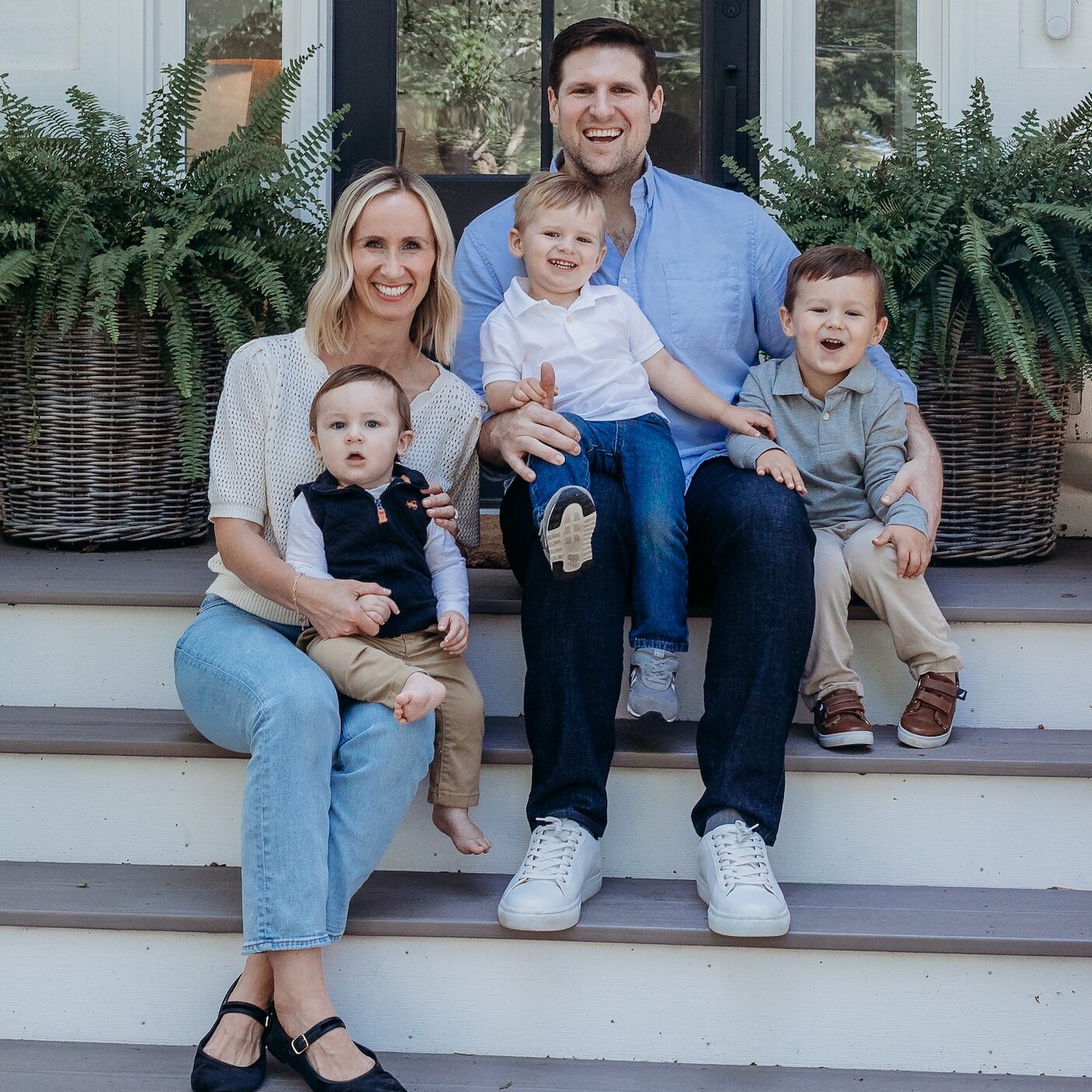

After coaching more than 2,000 moms in the last 8 years of coaching, and having 3 boys in 3 years, I’ve come up with parenting rules that I live by. These are rooted in both positive psychology, parenting, and my professional experience as a coach and mom.
These parenting rules are rooted in connection and focus on me showing up as the mom I want to be—not a perfect mom, but an intentional, human mom.
With that, let’s dive in.
I don’t use timeouts.
I don’t use timeouts with my kids—and it’s not because I don’t believe in discipline.
It’s because timeouts teach separation at the exact moment a child needs connection most.
When your child is struggling—melting down, acting out, overwhelmed—that’s when they are the least resourced. Sending them away in that moment communicates: when you’re hardest to be with, I don’t want to be with you.
Even if that’s not your intention, it’s often how it’s experienced.
Over time, this can create a subtle but powerful belief: I’m loved when I’m behaving well, and I’m sent away when I’m not.
That’s conditional love.
I don’t want my kids learning that they have to be calm, happy, or “good” to stay connected to me. I want them to know that my presence is steady—even when their behavior isn’t.
Resources:
- How To Be A More Patient Mom: Overcoming Guilt And Frustration (blog post)
- 200 Affirmations For Kids (download)
- How To Validate Your Kids Feelings (podcast)
- 40 Of The Best Parenting Tips (blog post)
- Whining And Complaining In Kids (podcast)
I hold boundaries, but without shame.
I hold very clear boundaries with my kids—but I don’t use shame to enforce them.
Shame sounds like: what’s wrong with you, stop acting like that, you’re being bad.
It attacks who your child is, not just what they did.
And when a child feels shame, they don’t learn. They shut down, get defensive, or escalate.
So I separate the behavior from the child.
I correct what happened without making it mean something about who they are.
You can’t hit.
I won’t let you speak to me that way.
That’s not how we treat each other.
The boundary is firm and clear.
But my tone, my energy, and my presence communicate: you’re still safe with me.
That’s how I teach respect and emotional safety at the same time.
Resources:
- Lighten Up Motherhood (free course)
- 15 Phrases To Use When Your Child Doesn’t Listen (blog post)
- When You Don’t Like Playing With Your Kids (podcast)
- Tantrum Guide: How To Stay Calm And Help Your Kids (download)
- How To Teach A Growth Mindset To Kids (blog post)
It’s not a one-way street.
My kids don’t exist to just listen to me—I’m in relationship with them.
That means it’s not one-way where I talk and they comply. I listen, I consider, and I model what it looks like to be in a respectful relationship.
If I snap, I repair.
If I’m short, I take responsibility.
If I get it wrong, I say so.
Not because I’m unsure of my authority—but because I’m confident enough to own my part.
I don’t expect perfection from them while excusing it in myself.
Respect goes both ways.
And when my kids experience that, they’re more open, more connected, and more willing to listen—because they feel it from me first.
Resources:
- My Top 7 Parenting Tools (podcast)
- Tantrums And Intense Meltdowns: My Tips And Experience (podcast)
- Life Lessons Every Mom Should Teach Her Kids (blog post)
- Tantrums And Intense Meltdowns: My Tips And Experience (podcast)
- I don’t punish my kids. Here’s why. (podcast)
I give age-appropriate answers to questions.
I answer my kids’ questions honestly—but in a way they can actually understand.
I don’t over-explain or give them information they’re not ready for. And I don’t shut them down with “because I said so” when they’re genuinely curious.
When kids ask questions, they’re trying to make sense of the world.
So I meet them at their level.
Simple. Clear. Direct.
Just enough information to answer what they asked—without overwhelming them or avoiding it altogether.
This builds trust.
They learn they can come to me, ask anything, and get a real answer that makes sense to them.
Resources:
- Alternatives To Punishment (And Why I Don’t Punish My Three Boys) (blog post)
- 7 Parenting Tools For Type-A Moms (blog post)
- 15 Activities To Increase Connection With Your Kids (blog post)
- When Your Child Has A Challenge You Wish They Didn’t Have (podcast)
- Mom Like It’s Your Job (podcast)
Connection is the foundation.
Connection comes first in my parenting.
Not after the behavior. Not once everything is calm. First.
Because connection is what makes everything else work.
When your child feels connected to you, they’re more open, more cooperative, and more receptive to your guidance. Without it, everything feels like a power struggle.
Connection doesn’t mean permissive. It means present.
Eye contact. Getting on their level. A calm tone. Letting them feel seen before you correct or redirect.
Connection creates influence.
And I want my kids to listen because they feel connected to me—not because they’re afraid of me.
Get my Connected Parenting Framework inside the Mom On Purpose Bundle here.
I let my kids lead.
I don’t decide who my kids should be—I let them lead.
Their interests, their hobbies, what they’re drawn to, how they express themselves… I trust that.
They don’t need me to shape them into who I think they should be. They need space to become who they already are.
That means I’m not forcing activities, projecting my preferences, or steering their life in a direction that looks good to me.
I pay attention to what lights them up—and I support that.
Because they know themselves better than I ever could.
My role isn’t to control their path.
It’s to guide, support, and trust them as they create it.
Resources:
- How To Make Meaningful Moments With Your Kids When You’re Busy And High-Achieving (blog post)
- 10 Affirmations I Say To My Kids (blog post)
- 9 Phrases I Don’t Say To My Kids (blog post)
I stay out of “get my child mode.”
I don’t make it my job to constantly fix, correct, or “get” my child to behave a certain way.
That energy—get them to listen, get them to stop, get them to do it right—creates pressure, tension, and power struggles.
And my kids feel it.
When I’m in that mode, I’m not leading. I’m reacting.
So I stay out of it.
I focus on how I’m showing up—calm, clear, grounded—and I let that lead the moment.
I still guide. I still hold boundaries.
But I’m not chasing behavior or trying to control every outcome.
Because the more I try to “get” my child to change, the more disconnected we both feel.
And connection—not control—is what actually works.
Resources:
- How To Stay Calm When Your Child Has A Meltdown (12 Phrases To Try) (blog post)
- How To Stay Calm During Your Child’s Tantrums: Strategies For Moms (blog post)
- How To Help Your Child Through Challenges Without Worrying And Fixing (blog post)
- Why Gratitude Won’t Solve Your Motherhood Problems (blog post)
Repair is a must whenever I mess up.
I mess up sometimes—and when I do, I repair.
Not later. Not vaguely. Clearly and directly.
I don’t justify it or brush it off. I take responsibility.
I shouldn’t have spoken to you like that. I’m sorry.
That matters.
Because it shows my kids that mistakes don’t break relationships—avoiding them does.
Repair builds trust.
It teaches accountability, emotional responsibility, and what it looks like to come back together after something goes wrong.
I don’t need to be a perfect mom.
But I do need to clean up my side.
It’s less about discipline and more about leadership.
I’m not focused on controlling my kids—I’m focused on leading them.
Discipline, in the traditional sense, is often about getting behavior to change quickly. Leadership is about how I show up consistently.
My tone.
My energy.
My clarity.
I’m not reacting to every moment trying to correct them. I’m guiding them with calm authority.
That means I’m steady when things feel chaotic. Clear when there’s a boundary. Grounded instead of reactive.
Because my kids don’t need a perfect enforcer.
They need a leader they can trust.
Resources:
- How To Get Your Kids Out The Door Without Stress:7 Parenting Strategies For Smooth Mornings (blog post)
- 7 Gentle Parenting Reminders To Make You Feel More Connecte To Your Kids (blog post)
- Tantrum Guide: How To Stay Calm And Help Your Kids (download)
We talk about (and normalize) feelings.
We talk about feelings openly—and I treat them as normal, not a problem to fix.
There’s no “don’t cry” or “you’re fine” when they’re clearly not.
Instead, I help them name what’s happening.
You’re frustrated.
That felt disappointing.
You’re really upset right now.
Feelings are allowed.
Not all behavior is—but the feelings behind it are.
This teaches them that emotions aren’t something to avoid or push down. They’re something to understand and move through.
And over time, that builds emotional awareness instead of emotional avoidance.
A Final Note
It’s so easy to want a “quick fix” for parenting but that assumes there’s something to fix. The truth is: there’s not! It’s a relationship you have with your kids and connection is the foundation. When you prioritize this, you can add on tools and skills to help you show up as the mom you want to be. This all comes together by the way you lead yourself in motherhood and as a mom.
There’s no “one right way” to parent and be a mom. But there are tools and strategies to help you build the skills you need to lead your motherhood and parent the way that feels the best to you. That is what Mom On Purpose Is all about. I’d love to see you inside.