I have 3 boys under 5 years old, and I’m genuinely not overwhelmed. That doesn’t mean life is perfect, my house is spotless, or parenting is always easy. It means I solved overwhelm from the root cause. In this episode, I share who I used to be—a type-A, high-achieving former lawyer whose identity was built on doing more—and how that wiring created overwhelm in motherhood. I break down the real cause of overwhelm, the mindset shifts that changed everything, how I use my Time Freedom Method, and why refusing victim mentality has been life-changing. If motherhood feels heavier than it needs to, this episode is for you.
If you’re a mom, you’re in the right place. This is a space designed to help you overcome challenges and live your best life. I’d love for you to join me inside the Mom On Purpose Membership where we take this work to the next level.
Listen to the Full Episode:
Show Resources
- If you loved what you heard on the podcast, check out my Mom On Purpose Membership.
- Grab my free Podcast Directory for the best episodes to listen to, listed by category.
- Come find me on Instagram so we can connect.
- Sign up for the Mom On Purpose Weekly Newsletter to get a tool, tip, or resource sent to your inbox every Thursday.
- Call the Podcast Hotline here: 8-333-ASKNAT (833-327-5628)
Full Episode Transcript:
Welcome to Mom On Purpose, where it’s all about helping moms overcome challenges and live their best lives. My hope is by being here, you are more inspired to become the mom you are made to be. I’m Natalie, your host, a wife, boy mom, dog mama, Chicagoan, and former lawyer turned professionally, certified coach. If you’re here to grow, I can help. Let’s go.
Hello, my beautiful friends. Welcome to the podcast. How we doing today? I’m doing really well. I was thinking about my life and motherhood and having three under five and some of the mom content that’s just come up on my feed randomly is like suggested content to follow or engage with. And then obviously I’m always thinking of all of you, all the listeners and all of my clients and overwhelm seems to continue to be a thread, in terms of what’s coming to my attention that we need help with as moms.
And I genuinely like do not feel overwhelmed with three under five, but that also doesn’t mean that everything is perfectly put away and there aren’t more things to get done. And you know, it’s not a huge mess and there’s not a lot of chaos. There is all of that. I just don’t feel overwhelmed by it because I am religious about thought work. I have made decisions in my life. I would not change them. I want to continue living into these decisions. I love my family. I love being a mom. I have three under five and it’s so messy. I’m using that word obviously that’s an interpretation, right? That’s my thought. But I’m using it in a really intentional way here because the kind of, I don’t know, rhetoric, if you will out there is like, we’re always triggered by a mess, right? And I can definitely relate to this.
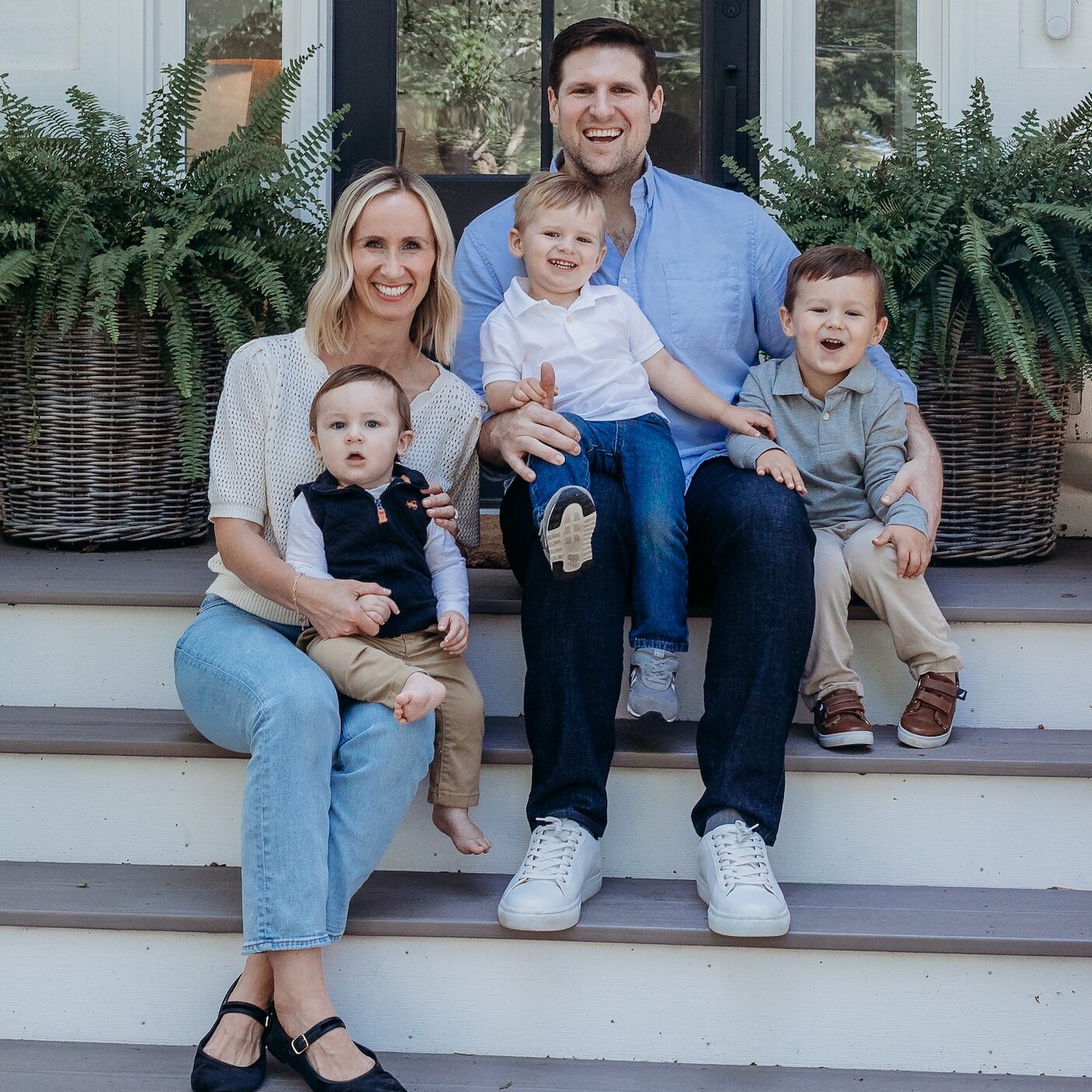
My former self, in different versions of my life, everything was clean and white and pristine and you know, there were no messes. When you have little kids, everything is a mess. And what I mean by that is like there are piles of laundry and toys in different places and, things left undone. And, and that’s like the way of it. And that is true in my life. That’s what I want you to know. And I also want you to know I don’t feel overwhelmed, okay? Both things are true. There’s a lot going on. I have three boys under five. Jack is one and a half. Henry is two and a half, and Robert is four and a half. Like, oh my goodness. It’s just like such a sweet time. We’ve got two dogs, Penny and Benji, mini Goldendoodle and Mini Bernadoodle. My husband works full time.
We live in the western suburbs of Chicago. I love it here. Very, very family friendly. And there’s just a lot going on. I run my coaching practice. I’m telling you all of this because for some people listening, it’s relevant. It’s like, well, you know, you must have four nannies in full-time help or something like that. Or you probably have in-laws or your parents come over and whatever, right? We all have reasons that justify are overwhelm and you know, some of them are justifiable. It’s really just a matter of like, do you want to continue experiencing overwhelm or not? So I like to just give a little bit of background because, even just transitioning from my husband used to work from home like full-time and that changed last year and it was a huge adjustment for me. I was like, oh, this is way different.
And so it took a while to get into our new rhythm for me to manage my brain, for me to reset expectations and change my work schedule. And I teach the Time Freedom Method. I actually taught it this month inside the Mom On Purpose Membership. As soon as you join, you get it. I really think you have to have that as your framework because it’s a results based planning system that works like extraordinarily well for getting rid of lists, right? Because lists, are really difficult for your brain. Your brain does not like a list. It, it will feel like, things are left undone. There’s not enough time. Your brain can’t know when things are going to get done and your brain doesn’t like that. And so it feels urgent and rushed and so no lists. Okay? The only list I have is a grocery list.
And so I teach in Time Freedom, exactly how to put everything on your calendar. And it’s not about doing the most, and I’m all for you doing more. My friends, I talk about this all the time, but it’s about just being intentional and more mindful with your time. It’s like, okay, what do I want to spend these 24 hours doing? How much time am I going to dedicate to sleep? And how often am I going to get up with my kids? Is it every time they’re up? Okay, well then sleep might vary and that’s a choice. And owning that, it sounds so simple and it really is , but the payoff, my friends, is huge. It is teaching my nervous system that it’s safe and I am still good when it’s kind of crazy and messy and like that’s truly life changing work for a high achieving type, a firstborn former lawyer, always responsible, always capable, always the one to handle things like my work in life.
Was not like how to set and achieve a big goal. My work in life was how to take a nap in the middle of a day on a Monday. Okay? And who knows why? Could be just, you know, first born life could be my upbringing. I was definitely more vigilant and hyper responsible with the family dynamics. My dad was an alcoholic and died several years ago from alcoholism, and my parents divorced when I was 12. And I really just took on this fixer identity from a young age. And I don’t think you have to have any sort of childhood like mine for this to be your experience. I think that some of us are just wired and I think believe deeply actually. I don’t just think is my opinion of lots of evidence for this, that the way that women are praised really validates being in fix it mode.
It’s like we are praised for getting a lot done for our house being tidy, for the kids, being well-behaved. I’ve pretty much just done thought work to unwind all of that. Like, it’s okay if my kids are acting crazy in public. It’s okay if they’re messy. It’s okay if my house is messy, like I’m good inside. Like I feel worthy, I feel happy, I feel connected. And it’s hard, right? There’s meltdowns. The kids are fighting, they’re, you know, fighting over throwing something, fighting over a car, like, throwing things like, you know, you name it, toddler stuff, three under five my friends. And so I’m just sharing more of my experience with you to add layers to it because there’s nothing unique about my life, but I do think it’s, a different approach because so much of what’s out there is deep breaths.
And after you’re feeling overwhelmed and after you’re feeling frustrated, and after you’re feeling frantic and manic and hurried, calm your nervous system down and take deep breaths. And that’s just, I like to say 80 20, that’s like 20% of the work. 80% of the work is on me just identifying my thoughts, questioning those thoughts and changing them. Okay? And the more you do this, the, the more the tool becomes a skill and then the more your capacity increases and then the better your life gets. Because, you know, it’s not like everything’s perfect here, right? It’s just that I’m less bothered by the imperfections.
So in a real practical way, when challenges come my way, when my kids are having meltdowns, when plans get canceled, when something unexpected with my, happens with my husband’s job or whatever, it’s like brain management deciding how I want to think and not just letting any old sneaky thought get up in there. And so the thoughts on default that we are wired to have as women create overwhelm, they just do because we’re praised for having a clean home, having well-behaved kids. Like what does that even mean? Like many adults that follow the rules and are quiet, I’m sorry, I’m not, not raising those kind of kids. Like we’re here to take up some space, definitely going to be respectful, but also like they’re kids. And I think it’s just such an American thing to, to do that, to like exclude kids. We were talking with my, or my mother-in-law was talking with my brother-in-law and sister-in-law.
They were going to church and we were talking about how like in a lot of churches here they have like the kids’ room, like where, like where you take the kids or the baby, right? Like they’re kind of excluded. And I never thought of it in that way, and that’s just not the case. Where they’re living abroad. And I was just thinking about that and it reminded me of one of the books I read early on when I became a mom about the different, I don’t know, cultural narratives around kids being like a part of society. And it, it doesn’t mean that, that there are no rules and that kids are running the show. It just doesn’t mean it, it just means that there’s not that added layer of shame and judgment, okay? And so in a practical way, it’s like when your kid throws something in a restaurant or has a huge meltdown, it’s not like, that doesn’t matter.
And,the kid’s in charge and we just give the kid whatever they want. Like, it’s not passive, but here, right? And, and with a lot of my clients, how we grew up, it’s like this shame-based parenting where it’s like, you gotta punish your kid, right? You gotta remove ’em, you gotta punish your kid. You gotta make sure that never happens again. And then there’s all this shame as the mom because we’re so used to getting praised when our kids are “well-behaved”. Like, what does that even mean? So that then we make it mean we are bad when we’re not bad. Your kid just acted how he or she acted in the restaurant. It’s totally fine. And you know, I just think that by looking at my thoughts and changing my thoughts, like every day, right? I don’t fall into those traps, those worry traps, those fear-based traps, those, overwhelm traps, really.
So, like the bed, right? My bed, our bed, my husband and I’s bed left unmade 9.9 times outta 10, okay? Never in a million years would I have done that before having 3 under 5 kids. Most of their beds are not made either. I kind of just like throw the comforter on it, I don’t care. And I say that and it’s like, oh, I want to say it to convey a breath of fresh air. I don’t want to say it to convey like apathy towards my home, right? For me, I think about myself, you know, as the leader of this family with my husband Steve, and we are strategists, okay? You have to, you have to strategize. So the choices that you make about what to do, and when IE the order of priority in which you do things becomes your strategy. So we have this vase in our living room, and it’s kind of crazy that I keep it out actually.
I just love it. It’s just beautiful. It’s a Serena and Lily vase and it’s really big. And I have these like fake stems in it, and I’ve, I’ve had it forever actually. We’re on version two ’cause of what I’m about to tell you. But, anyways, like I keep it out and if Jack, you know, it’s always like around that 18 month age, right? Where they like know, but they don’t know. And so if he pushes it and is about to push it over and I hear, I don’t know, let’s just make up something like Henry and Robert in the kitchen,fighting over dinosaurs or cars or something that they’re playing with. I have a decision to make in that moment. And that decision becomes the priority and the strategy. So the priority is the strategy. So in that case, Jack’s about to knock a vase over and get hurt.
I need to prioritize that over Henry and Robert disagreeing about who’s turn it is with the toy that they’re playing with. Okay? So I’m mentally prepared for this. Now, this isn’t like being on the beach in Hawaii. This isn’t, how do I want to say it? Like this isn’t like, oh my gosh, I’m so glad that I’m choosing this right? But there isn’t this sense of overwhelm or overstimulation because I do the thoughtwork out of the moment to expect it. Let me just finish that story. When Henry was little and probably about the same age as Jack is now, he actually did knock that vase over and then I replaced it. And so when that vase is in jeopardy, I prioritize that. And this happens all of the time a lot of times I just move the vase into the kitchen high up.
If you’re wondering, why don’t I just get rid of the vase? I just, okay, I am, it’s, it’s up high right now. Anyways, the point is this happens all day long where I am the leader of the family and I’m just alone with my kids and I have to prioritize and that priority becomes the strategy, okay? And that helps me stay out of overwhelm and I just expect it to be kind of messy and crazy and like, and that’s what I signed up for. And just like, it, it sounds like this is like my whole mindset and it kind of is. And that’s what I wanted this episode to be about. But I’m not naturally calm. I was never easygoing. No one would describe me as easygoing in my personal life, right? Who just like knows me, right? I’m a go-getter. I’m a type A high achiever.
I always wanted to be a lawyer. Like I just, it’s just in me. And I love that part of me. I get to utilize that part of me that gets to manifest in my business, right? I love setting and achieving big goals. It’s so fun for me and I turn that dial way down when I am with my kids. But it’s not necessarily in the way that you might think. When I say I turn it way down, what I don’t mean is that I’m passive. And like, like let’s compare it to like literally being on the beach in Hawaii, okay? If I am in my go, go, go doer energy, getting a lot of work done, that’s one type of energy, right? Doer, high achieving energy. If I am on a beach in Hawaii that’s like calm, relaxing, like stress free, literally just doing nothing, okay?
When I am with my kids who are three under five, and my job is to keep them safe and to love them and to hold boundaries, right? And of course to, to be with them and lead them and feed them and be their mom and get them where they need to go and all the things, right? It is neither of those first two energies, thoughts and feelings. Okay? It’s not do or go go go high achieving mode. But it’s also not, I’m at the beach and you know, sitting around with a mocktail just enjoying the sun, not thinking about anything. It’s kind of like a little bit of both, but it’s its own way of being. I really like to think about it as warm and firm and it has like this leadership energy to it. I really love it because I’ve talked about this before.
I’ve definitely talked about it in the membership where I think about leaders who I respect in the world, just leading different situations that are kind of crazy and chaotic. Like I always think of like the emergency department at a hospital or, I, I think of the military and the military leaders and I just think of like calm and decisiveness and, making decisions quickly in the moment. Like, I think of these as skills and I was just coaching someone actually, and she’s like, yeah, but isn’t that kind of sad to think about? And I said, for me, no. And this is the, this is the, point of thought work that I really want to emphasize here is that’s why you have to coach yourself and learn how to coach yourself and get coached because thoughts feel different for everyone. So I love those thoughts because it, it really paints a picture to me of like my little family unit and these little tiny humans with little small brains that, you know, have no basically no capacity to regulate themselves.
They’re going to act crazy and, and push boundaries and that’s their job. Like, it’s my job to control my thoughts and my feelings and to lead them from this sense of, of groundedness, meaning my nervous system isn’t in fight flight, but also I’m not at the beach in Hawaii. It’s like, what do I need to do? It’s like triaging. That’s how I imagine it. I’m like, okay, what do I need to do next? Who needs help? How can I keep this person safe? Like, I don’t know, let’s go. Like I, I love that. That’s not to say that in the moment, especially if my kids are screaming that I’m like, I love this. Okay, that is not it. I’m just trying to talk with you. Like if we were having coffee together or your drink of choice, and I was like, I really don’t experience overwhelm, and you, you’re like, tell me more.
I don’t understand. Okay, this is what I would be telling you. And the reason is because of my thoughts. You have to do that. 80% out of the work, out of the moment work, okay? You have, I want you to think of your brain having two core parts. Your default automatic brain, that is your survival brain, okay? We all have this and I think high achieving women, like it’s amplified because you’re so smart that it’s almost like, it’s almost like on steroids. Like it’s got like a super battery pack or something. It’s like,it’s superpowered, okay? And that means you have urgent thoughts and negative thoughts and catastrophic thoughts. And that’s, that’s not because you’re bad or wrong or you did something wrong or your childhood, it’s literally just the survival brain doing what it is designed to do. Okay? That’s not something hypothetical that just comes out when you’re actually, you know, your survival’s actually at risk, okay?
This is present every single day. So right now, just think back to today your survival brain was offering you thoughts. What were they? Okay. They probably were not thoughts like, oh my gosh, I’m going to die. And so sometimes we hear like, oh, survival brain, that’s dramatic. And we imagine thoughts that would never be present in our own lives. I want you to think about your brain. So my brain will offer thoughts that would be, thoughts or like my old, my old thoughts would be like, I don’t want to do this. This is so hard. I can’t handle this. This isn’t fair. Why don’t I have more help? Kind of like my default brain loves to go to self pity. Okay? Your default brain might do self pity, it might do, something else, right? You gotta pay attention to your brain. Anyways, two parts of the brain I want you to think about, okay, for purposes of this overwhelm episode, then there’s the intentional, thoughtful brain.
This brain works more slowly, it’s thoughtful, it’s really powerful because not only can you plan what you’re going to do next week, right? My dogs can’t plan what they’re going to do next week. We have this capability, but you can also plan out of the moment what you are going to think and when you plan what you’re going to think, and then you practice those thoughts, that then becomes the new default way of thinking. I mean, there was a time where I would have been really triggered by a mess or would have thought my kids have to behave a certain way in order for me to be good or, like you just yell at your kids and you punish them. And so I I say that because I want you to know that I learned these tools and I took them so seriously and practice them as if it was like the most important thing because to me it is because legacy and family and, raising my kids is the most important thing.
And I had so much work to do on myself and that really kind of led me to it, right? With my family upbringing and then realizing, oh my gosh, like the work isn’t ever done. And it’s not work that you do because like you’re bad or damaged. It’s, it’s work we all have to do for our own wellbeing and growth. And it makes parenting so much better and easier because when someone else judges my parenting or you know, maybe it’s not my parenting, when they judge like my kids and then they make that mean something about me, I’m like fascinated by it. It’s not a big deal to me. I’m like, oh, that’s interesting. ’cause I know that’s about them and what they think. I don’t make my kids’ behavior mean something about me. Now I might decide, okay, we gotta work on this skill, right?
I’ll give you a perfect example actually just boy life over here where my husband, had previously like really got into like potty jokes with my boys and it was not a problem at all. This was just kind of like during our nighttime routine, like lots of potty talk, okay? Where it has become a problem is now the potty talk with the grandmas and the potty talk in public. And I’m like, oh my goodness, here we go. And I’m lighthearted about it, but I’m still teaching them, okay? We don’t say these words in public. We don’t make potty jokes to grandma. That’s not what she enjoys. And it’s really just something that you want to do, privately with your dad, okay? And so for me, yes, that is something I want to teach my kids and I will continue to teach that. And you know, Steve also agrees, and it was a learning moment for us.
And if someone judged me because they heard my kids, I don’t know, making potty jokes or something, I would know that that’s about them. Okay? Someone else’s judgment is about their brain and it’s okay for them to judge me. It’s fine, right? They’re probably right. I don’t know, I’m just not going to get wrapped up in that. Like for what, okay? And so all of this like plays into overwhelm because it feels like just another thing to manage. If you feel like you have to manage your kids’ behavior along with the managing of the household, along with the managing of your career, and along with the managing of like the meals for your family or whatever it is, right? If you have things that are taking up space in your mind that are outside of your control, you are going to feel a lot more overwhelm.
You really will. And I just, I don’t know, I just decide not to do that because I want to feel, I don’t know, joyful, happy at ease, right? It’s already hard enough. I don’t want to add more suffering to it, but I promise you I was not this way. And that’s really what I want you to see is that these are skills that you can learn and if you’re feeling like stuck or so overwhelmed, it is mental, okay? Overwhelm is just your brain’s perception of the number of things being too much like what’s on your plate is too much. And in part we’re going to get all of the things that you’re doing on a calendar so that you’re not operating from a to-do list. And that’s the time freedom. But then it’s mind management. It’s teaching your brain no brain. We are not going to worry about other people’s judgments of us, about our kids.
It’s just none of our business. Like, who cares, right? Meaning like, I’m just going to let them think and feel how they want to feel, right? I love, like Byron Katie’s business, have you heard of this? The three businesses she talks about. There’s like my business, your business, right? Their business, and God’s business. And whose business are you in? You want to make sure you’re in your business as high achieving women. We are taught to, be givers and take care of our family and like do a great job. And so not only is the primitive brain naturally externally focused, but as women, we have that playing into it so that we are extra supercharged, externally focused. So we are aware of our kids’ behaviors and their feelings and their patterns and our spouses and the neighbors, right? And like our kids’ teachers, like, we’re so aware of other people’s business, as Byron Katie would say, their thoughts, feelings, and actions.
The work is really to let go of that, turn it around and become more aware of your business, your thoughts and your feelings because it’s where you have the most control. And so an unmanaged mind met with modern motherhood is going to feel very, very overwhelming. And I just want to be an example to you that that is not the way it has to be at all my friends. So I want to invite you yes, into the Mom On Purpose Membership. As always, it is my favorite space. I just can’t say enough about it. But also if you would like to get into the private podcast, I did create an overwhelm podcast. It’s just, I don’t know how many episodes, seven episodes. It’s a private podcast, you just sign up for it, it’s completely free. You get like a podcast app, or, or it’s a podcast that you get in your podcast app.
It’s over at momonpurpose.com/overwhelm-podcast. So it’s overwhelm podcast, but it’s like with a little hyphen. I’ll also link to it in the show notes and I think if you go to momonpurpose.com, it should pop up. It’s called Breaking Up with Overwhelm. I’ve just noticed like a really big need for this and I want to make sure that you know, you listening to this, you’re in my world, that you know that there are tools and that with these tools, there is no reason that you should feel overwhelmed ongoing in the future. Like, you can do work on this no matter what your circumstances are. I had three under three then three under four, then three under five. And there’s a lot. And that’s why I started talking about like there’s messes and I don’t make the beds. And it’s, it’s not because, I don’t like nice things.
I just care about my own emotional wellbeing more than I care about a perfect house. I’m actually really proud of that work, my friends that I can like let things go around the house ’cause they’re not my highest priority. I don’t want to run around like manic trying to do everything, feeling exhausted than making myself like a victim of motherhood. Like I’m good, right? I got decisions to make. Family is number one being with my kids, spending a lot of time with my kids when they’re this young, feeding them, making sure they get where they need to be. And you know, being with my husband and us leading our family together and my business, my clients who you, I get so lit up working on my business. I’m not going to choose to fold laundry over working on stuff for you. I’m just not right now. Do my kids have clean clothes?
Absolutely. Could I hire stuff out? I could, like we have cleaners who come. Could I hire more stuff out? You know? Yeah, sure, maybe I will. But the the point is like, it doesn’t bother me. I don’t need that because I’m not using my home to validate my goodness. And it’s some of the best work you can possibly do because then you just make decisions about who you want to be, but you don’t need your circumstances to be a certain way in order for you to feel a certain way. Because when you become dependent on your circumstances being a certain way, like your kids being behaved in a certain way, your house being perfectly clean and everything done and put away, like when you depend on that for you to feel good, motherhood is so much harder, right? Because that’s just not the way of it.
We’ve got lots of humans in our homes and our worlds and they’re small. And even if they’re not small, right? Big kids have messy rooms too. And they’re, they have, they have other opinions as well. And it’s, it’s just a different type of heart as I know from so many of the clients who work with me who have older kids, right? But the reason that I can coach them and help them and can help you regardless of the age of your kids is because it’s about what’s happening in your brain. That’s it. We just gotta look at your thoughts. We gotta examine them, we gotta pull them apart, question them, and come up with better feeling thoughts. It’s so much easier and so much closer than you think, my friend. Alright, I love you so much. Thanks for being here. Hey, if you haven’t written a review yet, will you please, please, please, even if you have write a review, it means so much to me and I want other women to be able to get these tools because the more moms that hear this, the more impact that this work will have on families. That’s truly why I’m so passionate about it. Alright, my beautiful friends, I’ll talk with you next week. Take care.
Enjoy the Show?
- Don’t miss an episode, follow the podcast on Apple Podcasts or Spotify.
- If you haven’t already, leave a review in Apple Podcasts.